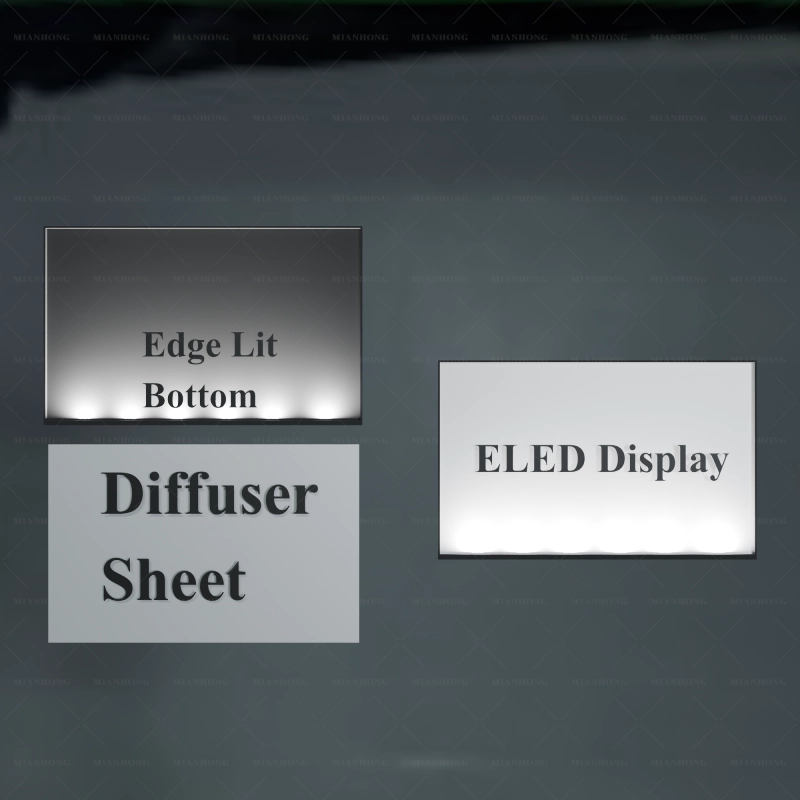
When comparing LED TVs, many buyers focus on screen size and resolution, but one key parameter is often misunderstood: Backlight Type.
Terms like DLED, ELED, Mini LED, and QLED are widely used in product descriptions, yet they are frequently confused with panel technologies. In fact, these terms mainly describe how the traditional LCD TV is illuminated, not the LCD panel itself.
In this article, we explain the differences between these backlight technologies in a clear, practical way, especially from a manufacturer and wholesale perspective.
What Is DLED (Direct LED Backlight)?
DLED, or Direct LED, uses LED chips arranged directly behind the LCD panel, distributing light more evenly across the entire screen. This structure improves brightness uniformity and thermal management compared with edge-lit designs.
Key characteristics of DLED:
LEDs placed across the full back area of the panel
More uniform brightness and better contrast
Slightly thicker than ELED, but more stable
Better heat dissipation and longer lifespan
Cost remains well-controlled for mass production
Current market trend:
Today, most LED TV production has shifted to DLED, as it offers a better balance between cost, performance, and durability. For mainstream and emerging markets, DLED has become the standard backlight solution for reliable, long-term use.
What Is OD (Optical Distance) in DLED Backlight Design?
OD, short for Optical Distance, refers to the physical distance between the backlight module and the LCD panel. In a DLED backlight structure, OD plays a critical role in balancing panel thickness, brightness uniformity, and thermal performance.
A larger OD allows light from the LED strips to spread more evenly before reaching the panel, which helps improve uniformity. However, it also increases the overall thickness of the TV cabinet. Reducing OD requires more precise optical design, including optimized diffuser films, light distribution patterns, and LED layout.
With improvements in backlight structure and optical materials, modern DLED solutions are able to achieve much smaller OD values than before. In our current manufacturing process, the OD has been reduced to around 20 mm, while still maintaining stable brightness and uniform light distribution.
This optimized OD design allows DLED TVs to remain relatively slim, while preserving the advantages of direct backlight structures. It also improves thermal balance and supports practical considerations such as cabinet design efficiency and container loading, making DLED a well balanced solution for both display performance and large scale production.
Loading Quantity Comparison With Different OD
| Our TV Model |
OD (mm) |
Loading Capacity per 40HQ Container |
| 3215KX |
28 |
2400 units |
| 3215K2 |
20 |
2720 units |
Loading Quantity Comparison With Different OD
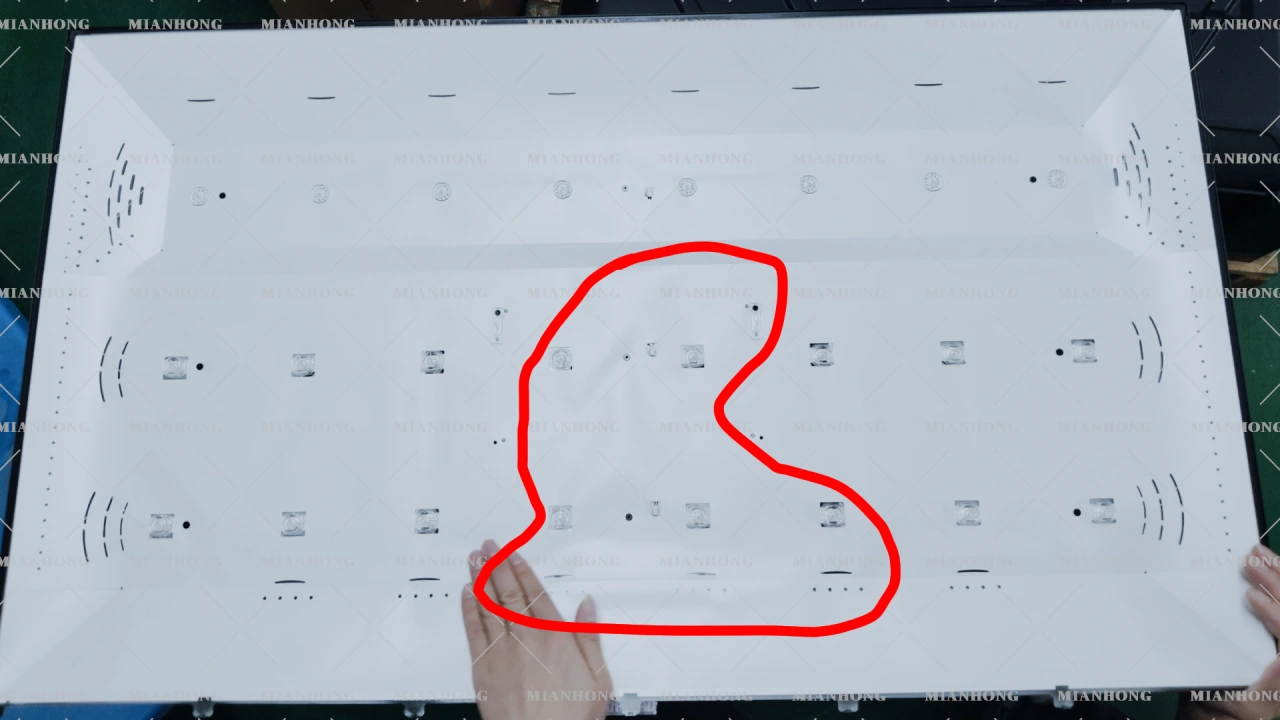
Although an OD of 20 mm brings many advantages, it also introduces higher manufacturing challenges for our customers. With such a thin distance between the backlight and the LCD panel, installing the diffuser sheet becomes more difficult. Any slight unevenness or bumps in the diffuser can result in visible bright spots or light shadows once the TV is fully assembled.
This is why, while smaller OD values improve cabinet slimness and container loading efficiency, careful production processes and precise optical alignment are required to maintain consistent display quality.
What Is MiniLED Backlight?
Mini LED is an advanced backlight technology for modern LED TVs. It uses much smaller LED chips than traditional DLED, enabling hundreds or thousands of local dimming zones. This allows higher brightness, better contrast, and precise light control, while keeping the underlying LCD panel.
Mini LED can deliver near-OLED performance in contrast and HDR, while retaining LCD advantages such as durability and cost-effectiveness for mass production.
Any backlight TV that supports local dimming can be considered a Mini LED TV. The presence of local dimming allows the TV to control brightness in different zones independently, which is the core advantage of Mini LED technology. Of course, the number of LED chips and the number of dimming zones will determine the ultimate display performance and the product price.
From a manufacturing perspective, this means that not all Mini LED TVs are created equal. TVs with more LEDs and more dimming zones can achieve better contrast, HDR performance, and more precise light control, but they also require more complex optical design and higher production cost.
In my view, when explaining Mini LED to customers, it is useful to focus on the functionality of local dimming and its effect on the picture, rather than just the term “Mini LED,” because the actual viewing experience depends on the implementation details.
DLED TV(left) vs Miniled TV(right). The mini LED does a better job on contrast due to local dimming technology.
Local dimming demonstration in a Mini LED backlight.
Backlight zones light up only where brightness is needed, improving contrast by keeping dark areas unlit.
Mini LED Strip vs Mini LED Backlight Board
In practical production, Mini LED backlights are mainly implemented in two structural forms: Mini LED strip designs and Mini LED backlight board designs. While both support local dimming, their structure and manufacturing requirements differ.
Mini LED strip designs place Mini LED chips on strip modules, similar to traditional DLED layouts but with much higher LED density. This approach offers flexibility in layout and cost control, making it suitable for a wider range of screen sizes and market positions.
Mini LED backlight board designs mount Mini LED chips directly onto a full backlight PCB. This allows extremely dense LED placement and finer dimming zones, resulting in better brightness uniformity and contrast. However, it also increases production complexity, cost, and thermal management requirements.
| Item |
Mini LED Strip |
Mini LED Backlight Board |
| LED arrangement |
Mini LEDs mounted on strip modules |
Mini LEDs mounted on full PCB board |
| Local dimming zones |
Medium to high |
High to very high |
| Brightness uniformity |
Good |
Very good |
| Manufacturing complexity |
Moderate |
High |
| Cost level |
Controlled |
Higher |
| Typical positioning |
Mainstream to upper mid range |
High end and flagship models |
What is QLED Backlight(Quantum)?
QLED is widely used in LED TVs to enhance color performance, especially color gamut and peak brightness. By improving how light is converted into red and green components, QLED TVs are able to display more vivid and saturated colors, which is particularly noticeable in HDR content.
It is important to note that QLED does not change the LCD panel itself. It is a color enhancement technology that works together with the backlight system.
Photoluminescent QLED Using Quantum Dot Film
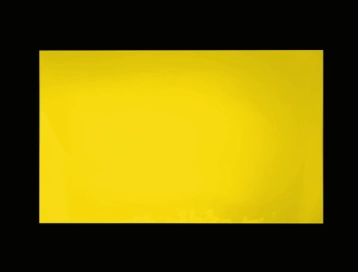
The most common and currently mass-produced QLED solution is based on photoluminescence. In this design, blue LED chips are used as the backlight source. A quantum dot film, which appears slightly yellow, is placed in the optical stack.
When blue light passes through this quantum dot film, part of the light is converted into highly pure red and green wavelengths. The remaining blue light, together with the converted red and green light, forms a wider and more accurate color spectrum. This method significantly improves color gamut while keeping the backlight structure relatively simple and stable.
From a manufacturing perspective, this approach is mature, reliable, and compatible with DLED and Mini LED backlight designs. It is also the most widely adopted QLED implementation in today’s TV market.
Electroluminescent QLED Technology
Another QLED concept is based on electroluminescence, where quantum dot materials emit light directly when an electric current is applied. In theory, this approach allows each color to be generated without relying on a blue backlight or color conversion films.
Electroluminescent QLED has the potential to offer higher efficiency, more precise color control, and simplified optical structures. However, this technology still faces major challenges, including material stability, lifespan, and large scale manufacturing consistency. As a result, it has not yet reached commercial mass production and remains primarily in the research and development stage.
What Is QD Mini LED Backlight?
QD Mini LED combines the advantages of Mini LED backlight technology and quantum dot color enhancement into a single display solution. By using a Mini LED backlight with local dimming together with a quantum dot film, QD Mini LED TVs are able to deliver higher brightness, improved contrast, and wider color gamut compared with conventional LED TVs.
From a structural point of view, QD Mini LED does not introduce a new panel type. It remains an LCD TV, but with a more advanced backlight system and optical layer design. This combination allows manufacturers to balance picture quality, production stability, and scalability, making QD Mini LED a practical choice for high performance large size TVs.
Conclusion
Understanding different TV backlight technologies helps avoid many common misunderstandings in the market. From ELED and DLED to Mini LED, QLED, and QD Mini LED, the key differences lie in how light is generated, distributed, and controlled, rather than in the LCD panel itself.
As backlight designs continue to evolve, factors such as brightness uniformity, thermal management, color performance, manufacturing complexity, and logistics efficiency all need to be considered together. From a manufacturing perspective, modern DLED and Mini LED solutions offer a balanced approach between display quality, reliability, and large scale production, while QLED and QD Mini LED further enhance color and overall viewing experience.
Choosing the right backlight type should always be based on actual application requirements, target market positioning, and long term product stability, rather than on terminology alone.
| Backlight Type |
Color Performance |
Max Brightness |
Local Dimming |
Price |
| ELED |
Medium |
Medium |
No |
Lowest |
| DLED |
Good |
Good |
No |
Low |
| Mini LED |
Good |
High |
Yes |
Medium |
| QLED |
Very Good |
High |
Depends on backlight |
Medium |
| QD Mini LED |
Excellent |
Very High |
Yes |
High |