-
Tel/Wechat/Whatsapp +86 13926285591
-
Email hanke@opeetv.com
-
Tel/Wechat/Whatsapp +86 13926285591
-
Email hanke@opeetv.com
2026 New Tempered Glass TV
In July 2024, we developed several tempered glass TVs, 43, 50, 55, 65, and 75 inches. In this article, we will show their workmanship and details.
About Mianhong: We are a professional OEM LCD TV factory located in Huadu District, Guangzhou. 13 years of manufacturing experience gives us enough confidence to connect with any LCD TV business. Our factory produces 19, 24, 27, 32, 40, 42, 43, 55, 65, 75, 85, 98 (100) inch TVs, equipped with smart or non-smart systems, and makes different formats (ATV/DTV) TVs according to different markets. In addition, we have a mature supply chain to cope with the spare parts (SKD, CKD) market. We can even develop in-depth cooperation and sell a set of TV manufacturing production lines and match our TVs to the target market.
If you need any TV wholesale or build a relationship with us, please contact us and we will reply ASAP!
What Is a Tempered Glass TV?
A tempered glass TV is a television designed with a tempered glass layer integrated into the front screen structure. Unlike a separate TV screen protector, the glass is part of the TV’s original design and is manufactured and assembled together with the display.
It should not be confused with a tempered glass TV stand or a removable TV screen protector.
Tempered Glass TV vs. Regular TV
| Feature | Tempered Glass TV | Regular TV |
|---|---|---|
| Front glass layer | Integrated(works as an extra layer) | No, only the glass substrate(fragile) |
| Scratch resistance | Higher | weak(sometimes there is coat layer) |
| Impact protection | Additional protection | No, only the glass substrate |
| Appearance | Premium glass front, but less screen-to-body ratio | Standard display surface |
| Weight | Usually higher | Usually lighter |
| Cost | Usually higher | Usually lower |
Front appearance design
Very sharp design with some silver edges. Since these TVs are LCD glass with tempered glass, they are as beautiful as mirrors when not turned on, showing a very perfect mirror effect.
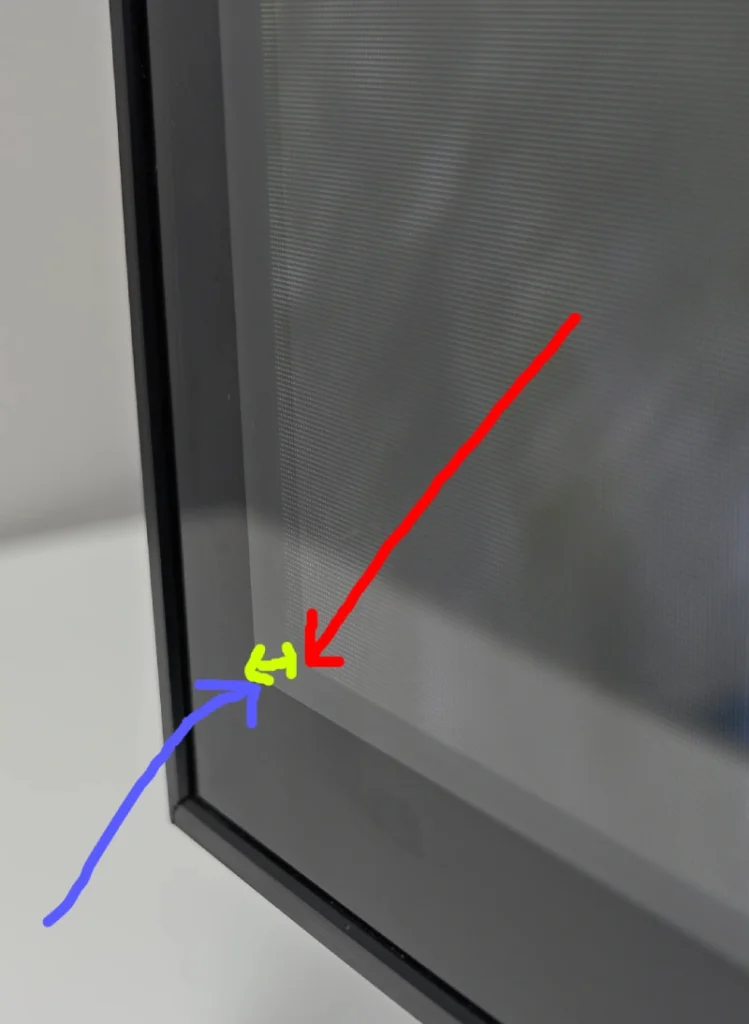
Of course, there are disadvantages when looking at the front, and if you are picky, you will notice that these tempered TVs have a large inner edge, which is the part marked in red. This is a feature of tempered glass TVs, because the tempered glass needs some space to “stick” to the LCD panel, usually a buffering strip. In addition, tempered glass is very heavy, and we need additional area to enhance the sticking effect. In this way, using a buffering and adhesive pad for tempered TVs is a two-pronged approach. If the center of a tempered TV is hit hard, the tempered glass will be responsible for dispersing the impact force to these inner edges.
In fact, the mirror effect of tempered glass is both an advantage and a disadvantage, like a double-edged sword. Because it has a mirror effect, it means that it can reflect indoor light. If a tempered TV itself is not bright enough, then its picture will be disturbed by the indoor light, resulting in a bad experience. Therefore, for tempered glass, we generally use an optical solution with 30-50 nits more brightness. For example, the conventional 55-inch is 230 nits, and we make it 270 nits to offset the disadvantages of this mirror effect. When the TV is turned off, it is like a mirror, and when the TV is turned on, it will not reflect indoor light.
Side Appearance and TV Stand’s Design
The tempered glass shell of the TV is very domineering. It has a silver cut-corner design and is also quite sharp. The silver frame on the side is all brushed. If you look closely, you can see the silver brushed effect, which is very elegant.
In addition, the TV’s feet also use the same metallic silver effect, which is very elegant.
It is worth noting that the feet of 55-inch and 65-inch TVs may be different. They are wide to ensure that a pair of feet are sufficient to support the TV with tempered glass.
Back Appearance and Ports Review
The design of the back is not very special, because we don’t see the back when we use the TV in daily life. But in fact, the shell we use still has some design sense in it.
Thanks to the extra inner edge, it actually protrudes a part of the “frame”, so when we look at it from the side, it gives a very thin effect. Then it extends in the “thick” direction to integrate the optical structure and motherboard. In addition, large sizes such as 65 inches will use a reinforced rib design.
Why is our tempered glass TV better than the so-called "Screen Protector"?
Our tempered TVs are manufactured with tempered glass, which is a built-in function; the extra glass purchased and pasted on the TV may be an acrylic film or a very fragile glass; these are two different concepts.
First, as mentioned above, our TV case is adapted to tempered glass, which means that we can embed tempered glass during production because the shell material has reserved a “groove” to install tempered glass.
Second, although the external method (i.e. acrylic film, or a large piece of glass pasted on the surface of the TV) looks easy to use, these materials will affect the display effect.
The acrylic film on the market is “hung” on the top of the TV, and then covers the display area of the TV downward to achieve an explosion-proof effect. But this has a big disadvantage, that is, the acrylic film will affect the display effect. After the color (spectrum) coming out of the LCD screen passes through the acrylic film, a part of the color will be lost, which is determined by the process of the acrylic film. If the acrylic film is also made of matte process, the display effect will be worse. In addition, for larger TVs, this acrylic film will be difficult to install. For example, after installation, some bubbles will be left between the film and the screen.
If you buy a large piece of extra heavy tempered glass, it is difficult to install it. First of all, the tempered glass needs a “sticker strip” to be placed on the TV screen. If the TV itself is a “frameless” TV, then the “sticker strip” will occupy the display screen. Maybe 1 cm will be occupied on all 4 sides of the TV to install the sticky strip to place the tempered glass. If the TV itself has a frame, if the frame has thickness, how to install the tempered glass? The answer is straightforward: buy custom-cut tempered glass and occupy 1 cm width in the display area to install the sticky strip.
Who Should Consider a Tempered Glass TV?
Not every TV needs a tempered glass front. However, in some markets and commercial environments, buyers specifically look for additional protection for the display. Based on our experience in the TV industry, tempered glass TVs are particularly popular in parts of the Middle East, including markets such as Syria and Yemen, where TVs may be used in retail stores, public-facing areas, or other environments where additional protection for the screen is considered important.
The same demand can also be found in parts of Southeast Asia. In the Philippines, for example, some small retail businesses such as sari-sari stores in local barangays may place a TV in a storefront or other public-facing area. In these situations, a tempered glass TV can provide an additional physical barrier in front of the LCD panel, helping reduce the risk of scratches, accidental impacts, or deliberate damage compared with a standard TV display.
Conclusion:
Tempered glass is more than just a visual design feature. For TVs used in retail stores, public-facing areas, commercial projects, and demanding environments, an integrated tempered glass layer can provide additional protection for the display while maintaining a clean and premium appearance.
For engineering applications, we can also customize TVs for environments where dust and other external conditions are a concern, such as mining and industrial sites. Depending on the application, we can provide appropriate dust-resistant design and enclosure solutions rather than simply adding an external protective layer.
As a professional TV manufacturer, we generally recommend specifying the protective structure during the TV design and manufacturing stage instead of adding acrylic sheets or separate tempered glass panels after installation. External protective accessories can increase installation and maintenance costs, and may also affect reflections, viewing quality, and the overall appearance of the TV.
If you are looking for tempered glass TVs for wholesale, commercial projects, or your own TV brand, we offer different screen sizes, designs, and OEM configurations to meet different market requirements. Feel free to contact us to discuss your application and requirements.
Thank you for taking the time to read this article. I’m Hanke, CEO at Mianhong TV. I hope this article has helped you better understand tempered glass TVs, and I’ll see you in the next one!
You May Also Like
FAQ
What is a tempered glass TV?
A tempered glass TV is a television with a tempered glass layer integrated into the front display structure. Unlike a separate screen protector, the glass is designed as part of the TV during manufacturing. It can provide an additional protective surface against scratches and certain types of accidental impact while also giving the TV a more premium appearance.
Are you the TV manufacturer(factory)?
Yes, we are. We are an LED TV OEM factory with 20 years of experience. Welcome to share your ideas with us. It’s our pleasure to provide the best TV solution for you.
What is your MOQ requirement?
Our MOQ is one model per 20GP and two models mixed loading in one 40HQ. Sometimes our MOQ is flexible, half of a 20-GP container is acceptable.
Is it possible to buy a sample?
Yes, it is. A sample is available to buy. However, our sample may charge double the normal price, which includes the following two parts:
- Customization and testing fees – The additional fees cover the engineering costs for us to customize and test the product according to your requirements.
- Sample deposit – An extra unit price is collected as a deposit. Once you place a formal bulk order after the sample order, we will deduct this deposit amount from the total fees of your bulk order.
This charging method ensures that we can customize and test the product specially for your needs, and also guarantees that once you formally place the bulk order, we can start production immediately without impacting delivery time.
Is a tempered glass TV the same as a TV with a screen protector?
No. A tempered glass TV normally has the glass integrated into the TV’s original structure, while a screen protector is an additional accessory installed over an existing TV screen. An integrated solution can provide a cleaner appearance and avoid the additional installation required for an external protective panel.
We are looking for long term customers and we will offer the best price!
Get A Price List of Double Glass TVs